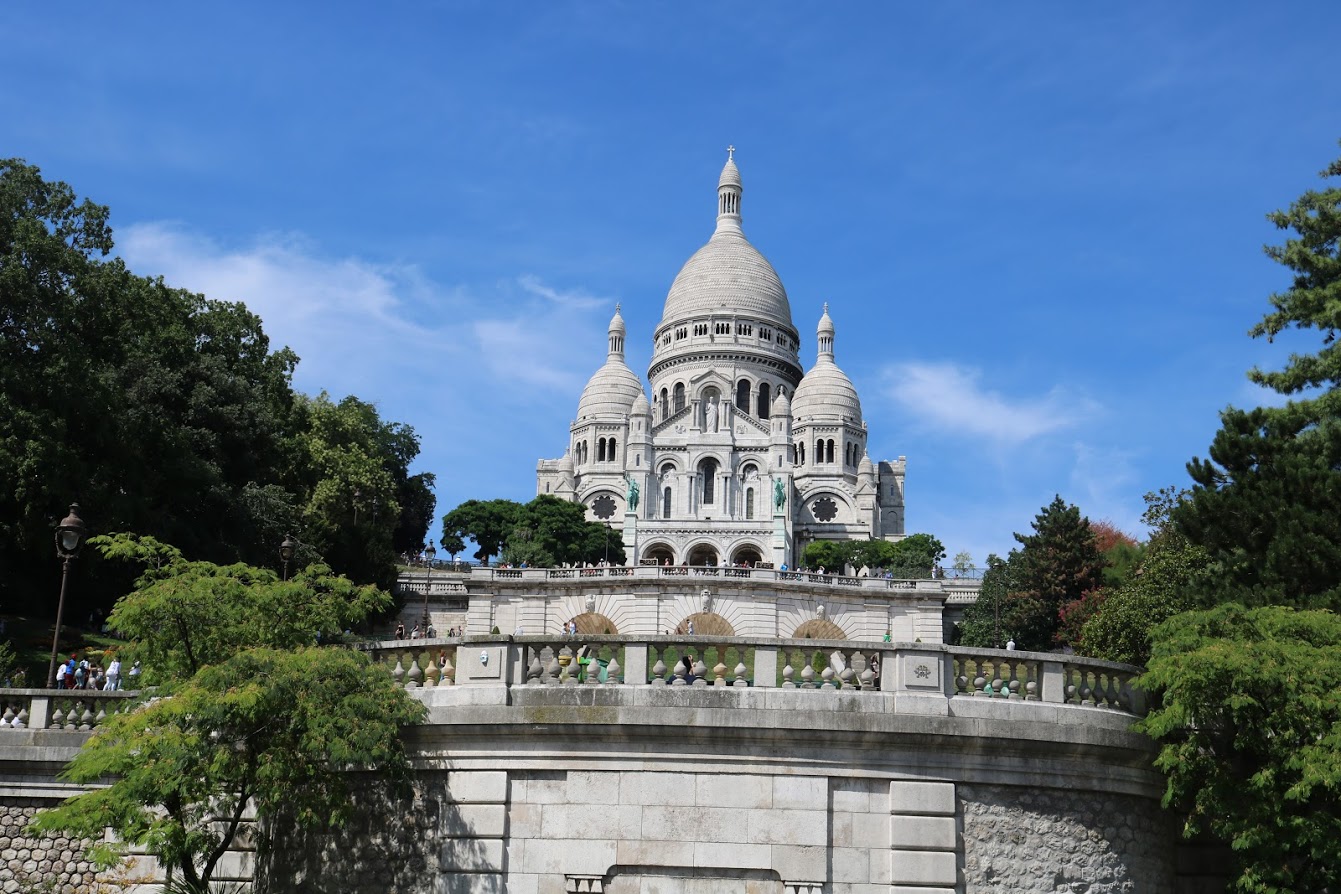
There is only one hill in Paris, and you can see it from the roof of the Arc de Triomphe, which is the one place Sophie told me she wanted to visit. I had pointed out the smaller arc, at the entrance to the Louvre, on our death-ride to the tourist office on Wednesday (was that really only three days ago—feels like a lifetime!!) but I think she knows she’s been fooled.
So on Saturday, after another breakfast on the warm patio with Noisette—the nut brown tabby cat– we load up and Irene drives us into the city with all our bags. Two nights is the longest we stayed at any one stop, so good thing we didn’t overpack. Good thing we don’t have suitcases full of stuff we don’t need and won’t use and wish we had thought through a little more–like an electric hairdryer, a tablet and a mini keyboard. Oh yes, and rocks. Good thing. I have brought along some James river rocks for souvenirs for my host families.
Our hosts for the weekend is the family of the French girl we hosted two summers ago. They live in a little flat in the 19th arrondissment right along the gates to Pere Lachaise Cemetery on the rue de la fraternite, which Irene thinks is a lovely name for a street. She shares that tidbit with me, peering over the steering wheel and staring hard ahead as we turn down this street and that, searching for their house, which she has visited once before. Last fall, when I announced plans for the grand voyage, my friends from 2016 contacted my friends from 1986 and in one phone call and an evening, knit together 30 years. Irene tells me fun things about their meeting. Anoukis’ family is Egyptian first, French second, so their apartment is very different from the village home of Irene and Claude. It is also very teeny, and quite full. They sit on piles of pillows, middle-eastern style, and drink espresso. Mona has fixed an authentic Egyptian meal. They are laying out plans for the American and her daughters coming to France the following summer. Remember the code of hospitality? Irene tells me that within an hour of their meeting she and her whole family were invited to Egypt. What else are they talking about, I wonder? This and that. The past? International travel? Their children? Anoukis has an older brother named Mnevis. “Yes” he says in impeccable English after we shake hands all around, “Mneveis was a lesser god. My parents had a thing for Egyptian gods and goddesses.”
Now, seven months later, I am seated on the same cushions eagerly waiting on an offered espresso (and the girls as well!). Who would say no to this nectar of the gods when we were awoken at 8 by jackhammers? I try to picture the two families together for evening which would not be but for the American travelers coming the following summer. Strangers, but for one connection: me. It’s nice to think about, in a way. Of all the changes three decades have wrought, this is a good one. And believe me, the decades are ever before me, the changes quite pointed and sharp at times: “What is a ‘French franc’?” says the 22-year-old bank teller at BBT when I ask if I can trade mine in or convert them to Euros. Like, SHE WORKS IN BANKING!! Is she laughing at me over the phone?? Really??! What do you mean, What’s a French franc?!! Well, if you have 2.2 of them and it’s 1986 then you have a baguette, and that’s a three-meal day for a student on foot, you say. You say, what the heck do you mean, “What’s a French franc?!!” Tell me there’s an enormous glass pyramid smack in the middle of the Louvre pavilion or tell me they’ve torn down bridges and built new ones; tell me that the spectacular “sound-and-lights” are no more, but don’t tell me my mad money has really, finally, gone round the bend. Of all the things that went away or came to pass without me, it is nice to think that this most lovely of constructions, a friendship, has grown in the place where I once was. A bracing shot of purpose makes me sit up a bit. On those pillows. I would like to go ‘round the world, planting connections just like this one.
One of those connections is about to be severed, and it is making me sad. Irene is handing us over. There is not enough French in me to express what I want to. It is the last time I will see her, and I know it, but that sharp fact is bumped and budged aside by arriving here, and meeting this new family. We are hauling our bags up three flights of stairs and into tiny bedrooms. Then we are sitting, offered a drink. It is hard to make an espresso last. Irene makes polite conversation with Mona and Mourad, relays in about six sentences what would have taken me twenty minutes and umpteen hand gestures to communicate, and we are a room-ful, enjoying a morning coffee. La fraternite. Anoukis comes down from the shower, Irene departs with a quick good-bye and we are saddling up for a day—or rather since it is now noon, an afternoon of sightseeing. By car. Sophie looks panicked at the prospect, fancying herself a city girl and wanting to stride those long legs along the quais and sidewalks of Paris. She wanted to take the Metro. I assure her that we will see more this way and move more quickly, which is, of course, not exactly what she was after. I think she knows it will be another trapped time: stuck in a room, or a car, or at table where everyone is speaking French. Except her. Think about how many plans and ideas and proposals and casual negotiations are taking place all around her, as we drive around and move and make plans—all in French. From Sophie’s perspective, there’s just a lot of noise and blather, not to mention abruptness—when we suddenly stop, park the car, hop out and we’re at the Arc de Triomphe.
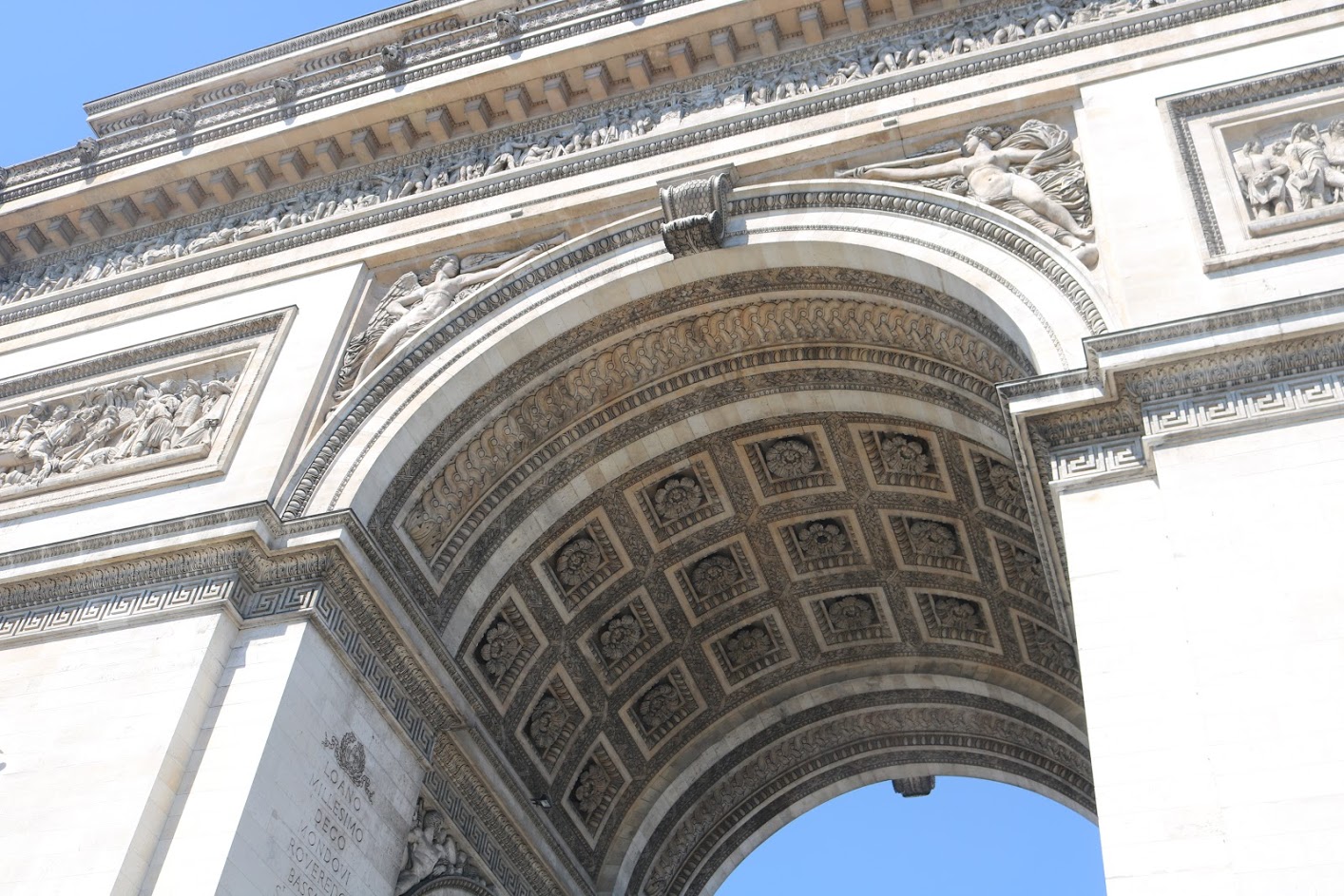
I resolve to translate more and try to keep her included in the rapidly changing evolution. At the moment, we are observing that the tourist lines for the monument are at a decent low, so up we go. Now we’re talking! Champs Elysees and the great boulevards of Paris (thank you, Baron Haussmann). Apparently, the French soccer team paraded this route only weeks ago, to the cheers of their adoring countrymen. Once again, we are able to cut the line, Ellie and me the only card-carrying tourists of the bunch, and the rest of them, Sophie included, flashing their best student smile (you’re supposed to have a student ID on you) and we’re up the stairs. Yes! Our first pigeons-eye view of the city. I point out the mount we are headed to, on a distant hill to the east.
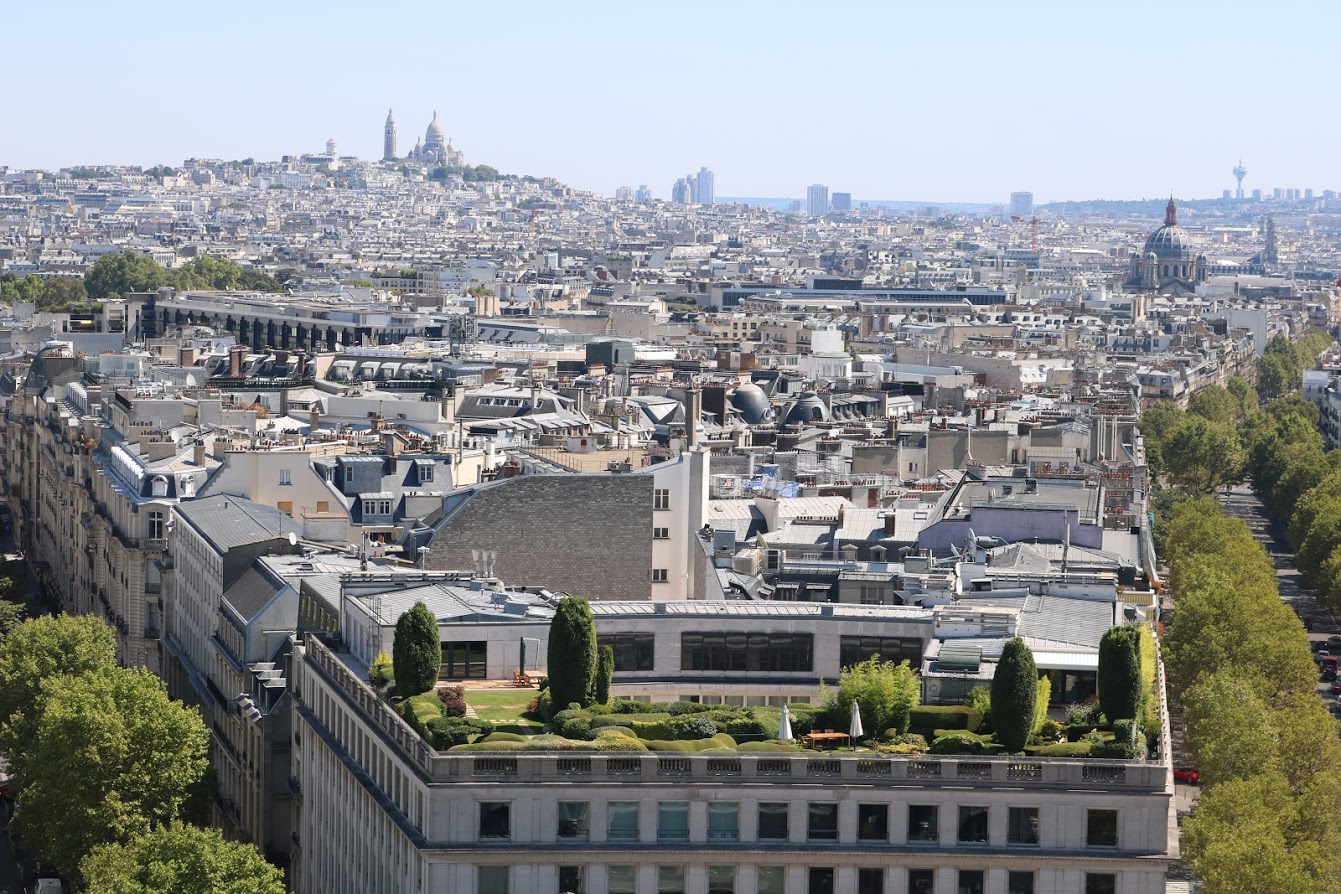
On that hill, the Mount of martyrs—or Montmarte—sits a white domed cathedral wearing onions for hats. Originally called “Mons Martis,” meaning the “Mount of Mars,” the site received a new Christian name in the third century AD when Denis, the first bishop of Paris, was marched up it to be crucified. Half way up, the Romans tired of their walk (sound familiar?) and lopped off his head right then and there. But Denis wanted to die like Christ, so he picked up his head and finished the walk. At the top of the hill he lay down and died, but the head, it is said, rolled back down the hill to a point that was later declared sacred, and where they built the Cathedral of Saint Denis. Everywhere you see a stone statue or a painting of a guy holding his own head in his hands, that’s Denis.
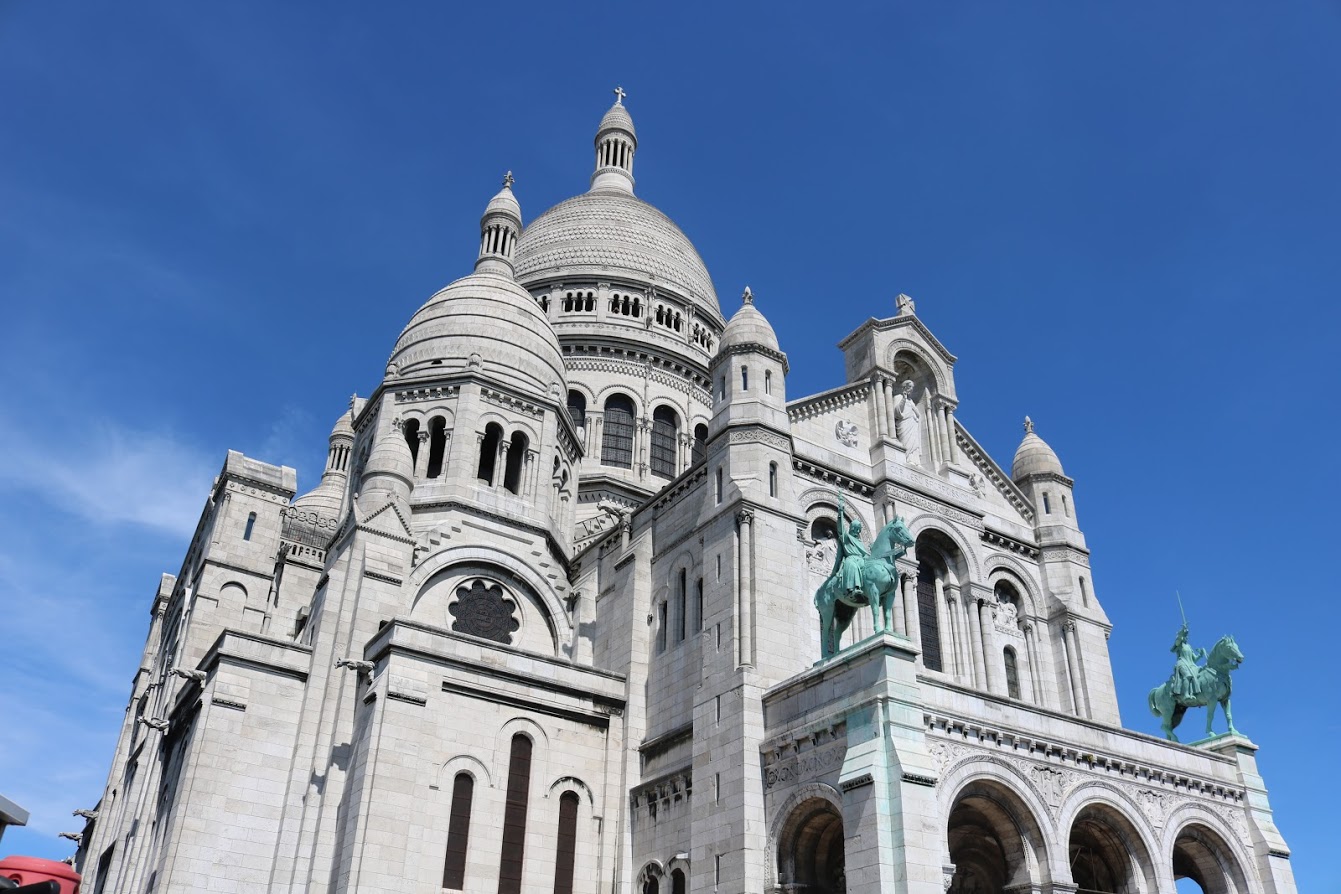
Today, the area is a favorite tourist crawl because of the Place de Tertre, an outdoor art fair of sorts, and the Place Pigalle, Paris’ own red light district. It’s a good pick for our little group of sight-seers, but whoo-eee, it is a crowded hike up the narrow, winding street. Sophie’s photos that I later view are filled with pictures of backs as we make our way up alleyways and “streets” of a thousand steps. Indeed, “Tertre” means steeped lanes in French, and there are certainly plenty of those. And plenty of people. This is Saturday in Place du Tertre, where artists still vie for customers and display their sketches and caricatures. Is it possible there are fewer here than I recall from the 80s? Perhaps they have moved on to the little postcard and souvenir shops that line the streets. We manage after some headless wandering to find a restaurant from my guide at the very base of the rue Muller. It is if anything a little cooler and quieter in the cafe, and it feels good to sit a little. Anoukis orders an American burger (!) and Sophie and I decide to split a large salad nicoise. And, of course, the necessary Orangina.
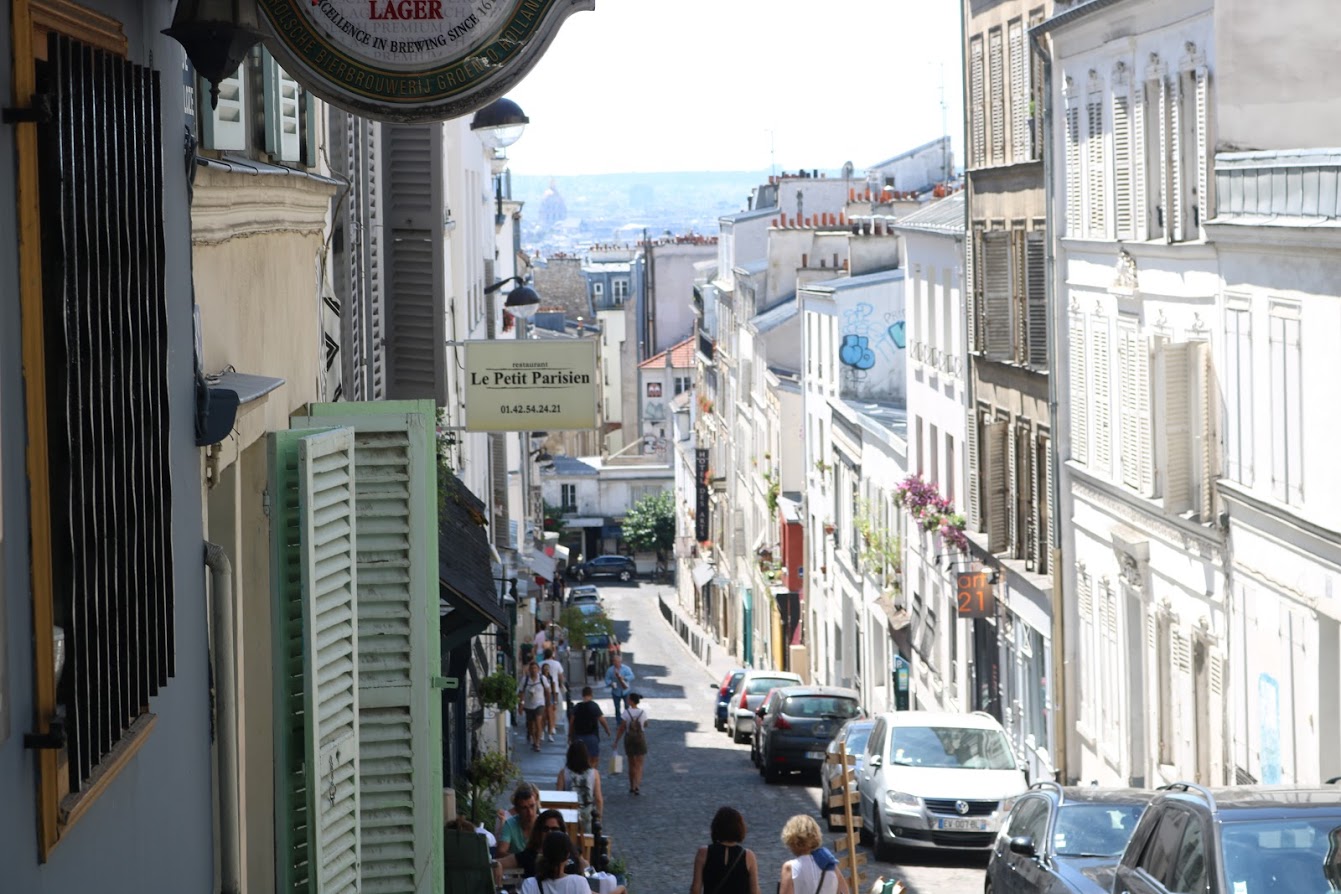
After lunch Mona proposes a tram tide – we have gone up only to come down for the restaurant only to mount back up to find the little train which is indeed the way to go, as packs of tourists part for it coming through on the streets. We tour the area just visited on foot, then Place du Tertre, then the Moulin Rouge and the red light district. Sophie’s eyes are wide, taking in the shop fronts as we ride along, where blinking neon and bold signage advertises what’s inside. No one has made pains to mask “sex shop” in French. After the ride we enter Sacre Coeur and tour the sanctuary, enjoying a “modern” cathedral, completed in 1914. It is cool and humid inside, and deliciously still; the walls and soaring pillars providing respite from the hot, crowded streets. It is strange visiting a “new” church that is nevertheless old enough to tell stories and huge enough to command attention. Next door is a little chapel celebrating 870 years. I can’t imagine even having the banners and bulletins printed for that one.
In this order we find (1) ice cream (ridiculous indulgence, as it is over three dollars per scoop) (2) a Starbucks, and (3) souvenir shops. We gravitate towards the few with AC. I find this one corner of an expensive little boutique utterly fascinating, as it is there that they have an air vent going full-bore, and I secretly hope that the girls will want to look at mugs and mats and little plastic Eiffel towers a while longer. We are still managing to move as a group, milling and enjoying the cobblestone, window sills, winding streets, but it is hard. It is hot. It is crowded. Perhaps on a Saturday there really is such a thing as a Parisian tourist…? Mom’s historic walking tour is decidedly out, even though I have the pages clipped and a pile to show them. Don’t they want to know about Renoir painting here? Or the America expats of the 1920s who hung out here and who wrote for their dinner?

Finally we are done. Or we think we are done. We wind our way back down the street, find the parked car, pile in. Mona decides that one more thing is in order (it’s 6:30 pm so I’m hoping the thing is dinner) and asks me where else we should go. I mention Pere Lachaise because I know it’s close to their apartment and I did want the girls to see it. Back in the day of student travel, anywhere outdoors, free and open late was the most desirable. None of this fighting for paid entry (Timed tickets!! Obtained on a cell phone! Ye Gads!). So I spent more time in Pere Lachaise than I did in the Louvre. Why not? It is, after all, a final “museum” of sorts.
But this time around it makes less sense. So I tell Mona that I planned to take the girls tonight by metro to Notre Dame to see the sound and light show. This, too, is a favorite of past travels and totally free—a spectacle of light projected on the façade of ancient buildings, usually with an audio component, telling of the history of the Cathedral and blasting really loud, sappy, majestic music. I used to love them. The one listed in my Rick Steves says 10:30 p.m., which makes perfect sense because then we could go home and get dinner and the girls and I could head back out after that. Sophie desperately wants out of the vehicle. She wants to ride a city metro, take sidewalks in stride, taste the evening air. One of the things about staying with a family instead of going it alone, however, is that our plans became their plans. And so, here we are, making an about-face two turns from home and headed off to Notre Dame. Sophie’s discontent at this development is matched by mine when we discover that no, the sound and light show is not happening here tonight. My travel guidebook is a 2016—practically brand new by my standards, so I am insistent. “Mais non, says the uniformed guard, C’est fini!” –acting as though the thing dried up years ago. Gone the way of the French franc.

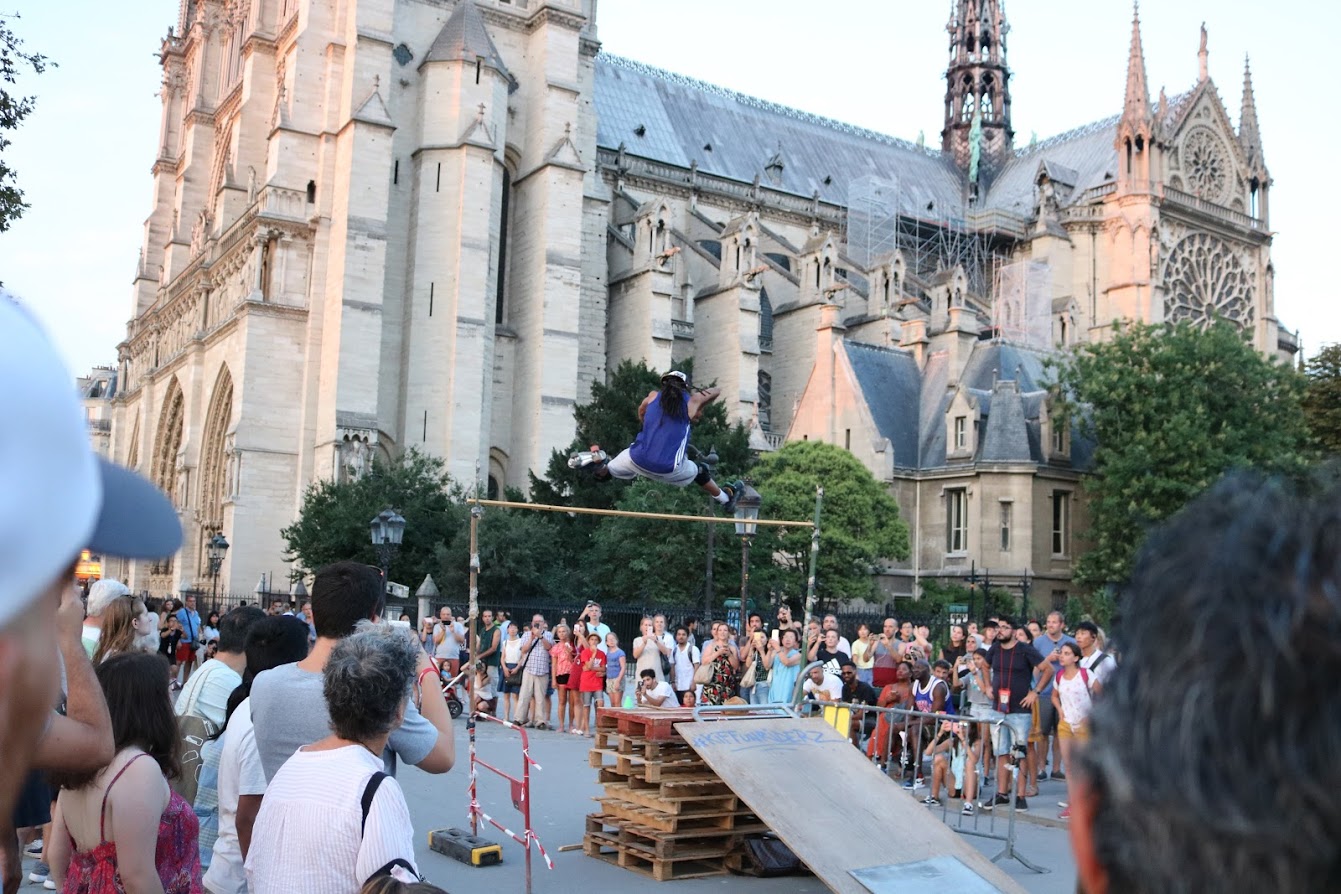
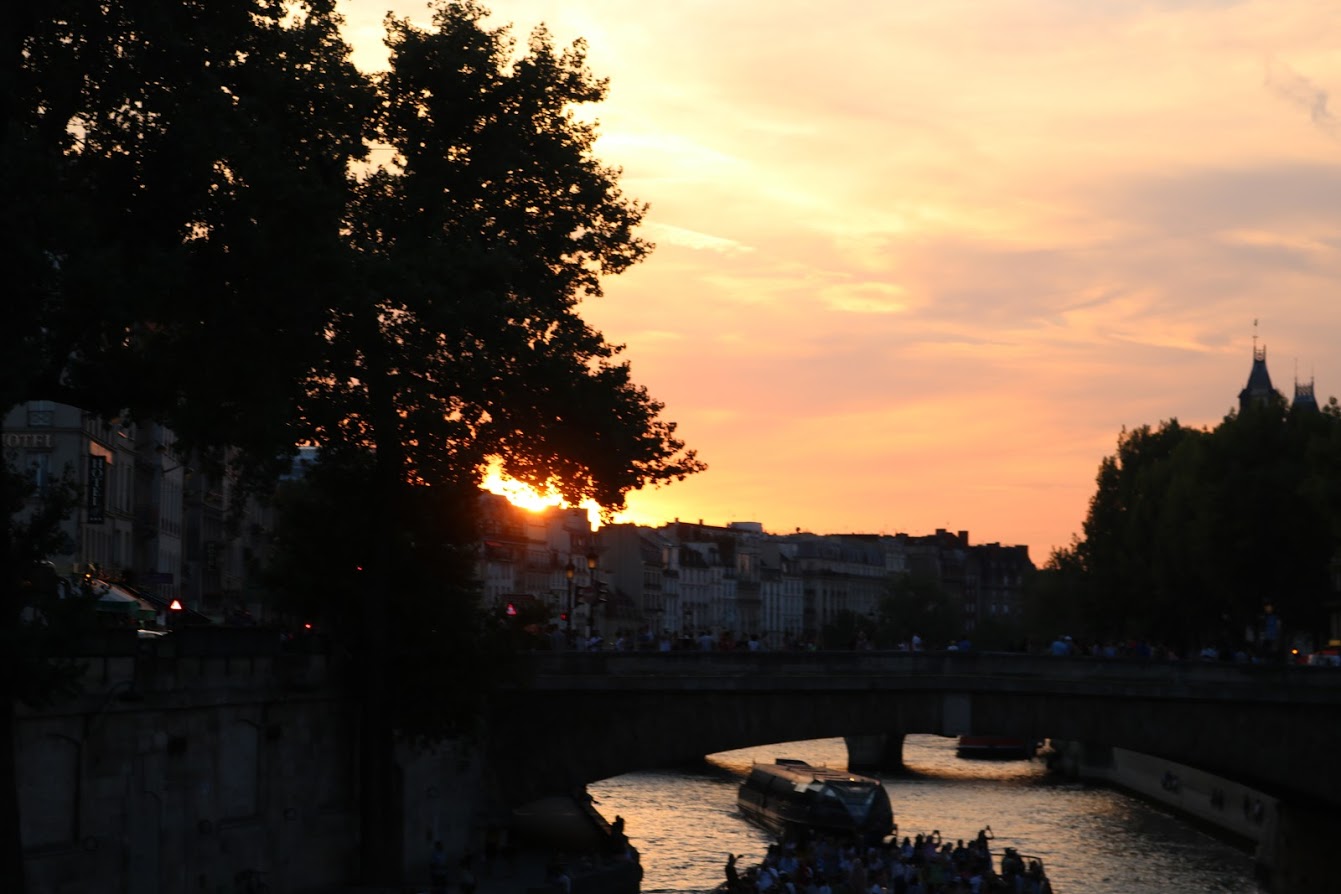
Now it is 9 p.m. on the pavement outside Notre Dame, at the heart of Paris (literally—the zero marker is set into a copper star in the paving stones under our feet): no dinner, no sound and lights and—sorry, Soph—another car ride away from home. Various levels of disappointment and exasperations cook in the two of us while Ellie, oblivious, takes in the evening sights on the giant square. It is no less crowded at this hour, but people are here with jackets, dogs on leashes, and it has grown cooler. The relentless sun is preparing her bed over the western corner of the city and I suppose that is one of the things that has drawn folks out. That and the street performers who have amassed quite a crowd on the pavement to the right of the church: men on roller blades jumping very high hurdles and then passing a hat. They are jumping 8, 10 feet in the modern air with a makeshift “pad” of wooden pallets and the 855-year-old-cathedral as a backdrop, so the images captured in film give quite a jarring juxtaposition: of dreadlocks and duct tape and skaters in saggy-butt jeans performing their stunts, while Our Lady of Paris in her stately gown of lacework and stone buttresses rises above it all. They are impressive, but we are impressively hungry. It is hard to move the headless group, but as last we leave and head for the little apartment.
Did I say little? I think property values must be exorbitant in the city. The bedroom of Anoukis is no bigger than a large utility closet. Maybe 6 feet wide. Maybe. She sleeps on a sofa bed which takes up 25% of the floor space of said closet. Fold out the large sponge chair/sofa thing and take up another 50% and you have basically a 4” x 3’ space to stand and …. well, look at beds. Moving, working, getting dressed—these sorts of activities will have to take place elsewhere. It is bed land. The room next to that is roughly the same size but has a desk at one end and a large armoire, out of which pulls a guest bed. This will be my little nest for the night and honestly, with the bone-weary fatigue from the day I could sleep in a laundry basket. Who cares if it is 80 degrees indoors and that opening the large wide windows brings in all the street noise and the neighbors having a heated argument—en francais, at 1 in the morning on their balcony.
And that is how I find myself seated next to Sophie at a dinner table at 11:00 at night eating organ meat and Egyptian fare. We are worn out, not really hungry anymore. Mona said she would make “un diner simple,” but this is far from simple. Once again, my angel daughters dig in, taking larger helpings than they ever would at home, and inside I am so grateful. I would chew gravel to have them behave like this at a hosts’ table. I decide not to let on what I know: that the large platter of roasted meat is duck, and that I’m pretty sure it’s some kind of organ meat mixed with the onions and pilaf being passed around the table. Our favorite is the Tamiya, little fried fava bean cakes, and—because this is, after all, a French home, a salad and a basket of bread. In France the bread is not sliced ahead of time; the whole baguette goes on the table or is cut into hunks and served out of a basket. We pass the basket, tearing off smaller hunks, and in so doing—in breaking that bread—we share the day, we share this hour and their hospitality. We share fraternity. We break down decades as we feast on friendship and share the future.

 Souvenirs
Leave a comment