Monday, August 6: Mont St Michel
The halfway point in our 10-day trip is also the highlight of our entire journey: Mont St. Michel. By now, we are three somewhat unique travelers: the French romantic, the returning pilgrim, the photographer—and this island arrests us, invites and delights us in very different ways. After this day, our trip becomes a journey.

It was a hard-won destination, back in the planning stages, as the site is four hours from Paris, nestled in a little crook off the southwest coast of Normandy. As southwest as you can be without being in Bretagne. By train or by bus, it would have been an expensive destination, and perhaps a superficial one at that, had we dropped so many euros to take a 7 am tour bus out of Paris for a “day trip” that would have spent much of its day on a motor coach. Had we taken a train, there could have been hitchhiking involved – or worse, the reality of being stranded. I knew that getting this place out of the guidebook and the 5-star Trip Advisor reviews and actually in front of us would be a feat. A feat involving an Egyptian-French family, their daughter and their little six-seater Peugeot rumbling along the back roads of Normandy. Did I say “rumbling”? Bah! Too romantic. More like “rocketing.” Who knows how long it would have taken had we traveled the speed limit–which on the A370 is 90 kilometers per hour?!! Instead, we arrive by car, with Anoukis and her family, who I gather has not seen the island for 20 years–and Anoukis, never. So I’m not the only pilgrim about to be boulversee.
It really does rise up out of the Norman lowlands like the last best thing happening before the sea. Or, more accurately, as a bit of magic happening at the edge of the sea. It is part Disney castle, part mythic fortress, all ancient eglise constructed stone by amazing stone to the Glory of God. It resembles a giant’s sand castle, carved right from the craggy rock and stone of the little island itself. Once again I have the feeling that I am simply witnessing a beautifully drawn movie set or beholding with believing eyes something that is not really there. My, but the CGI is good in these parts!
But it is there, where it has been since the 8th century. On the 16th of October in the year 709, Aubert, Bishop of Avranches, built and consecrated a small church on the Mont Tombe which at that time was surrounded completely by sea water but for twice a day. History has it that he was responding to the direct request of the Archangel Michael, whose likeness rises in gold atop the steeple spire—the tallest point on the island and one of the features that makes the whole island, from far off, look like a Christmas ornament. It is so perfectly compact, encrusted layer upon layer with rooftops, angles, steps and spires. There is something LEGO-esque about the way the buildings are stacked and nestled one atop another.
In 966 a community of Benedictine monks settled on the rock at the request of the Duke of Normandy and the pre-Romanesque church was built before the year one thousand. For the next millennium or so, the monks continued to build layer upon layer, expanding and reaching ever higher into the cloudless sky. It culminated in a three-story building off the north wall called the merveille – the wonder. I could not understand our guide well enough to understand how the merveille got its name. Was it because it was built in so short a time? Seventeen years (and four successive abbots) is a relatively short period of time for medieval construction; Notre Dame de Paris took almost 200! (Although the Washington National Cathedral, build a millennium later with modern tools, took 83!) Its bold architecture consists of three layered levels, culminating in a height of 35m, supported by sixteen powerful buttresses under which much is hollowed-out crypts. Perhaps the marvel lies in how much was spent? History has it that the funding came from the first king of France’s conquest bounty. Or how much it has endured–centuries of collapse, fire, weather extremes, wars, sieges –and yet it stands still–no, it soars. Soars to the glory of God. Because, as our eyes could see without a word from any guide: it was indeed a wonder. Every last stone hauled up the side of that cliff to the waiting masons poised even higher. In this regard Mt. St Michel has well earned its title as The Wonder of the Western World.

When I was there thirty years ago, the tour bus could drive right out to the island and park within its walls. Apparently, in that time, the sand and shifting tides have threatened the actual island-ness of the mount. Now that really would have been something. It’s one thing to go back in search of an old footprint and find a house torn down, a bridge built, a pyramid plopped down as some architect’s winning contribution. But to go back and find an entire bay evaporated into meadowlands would have been a shocker. Such was the prediction here for only 40 years. Happily, ecological awareness and care for the tides and the surrounding canal bed have prevented that, and a 10-year project commenced in 2006 has resulted in a state-of-the-art dam and canal system—a feat of environmental engineering whose sole objective was to restore the natural rhythms of the island and the sea–to nature!
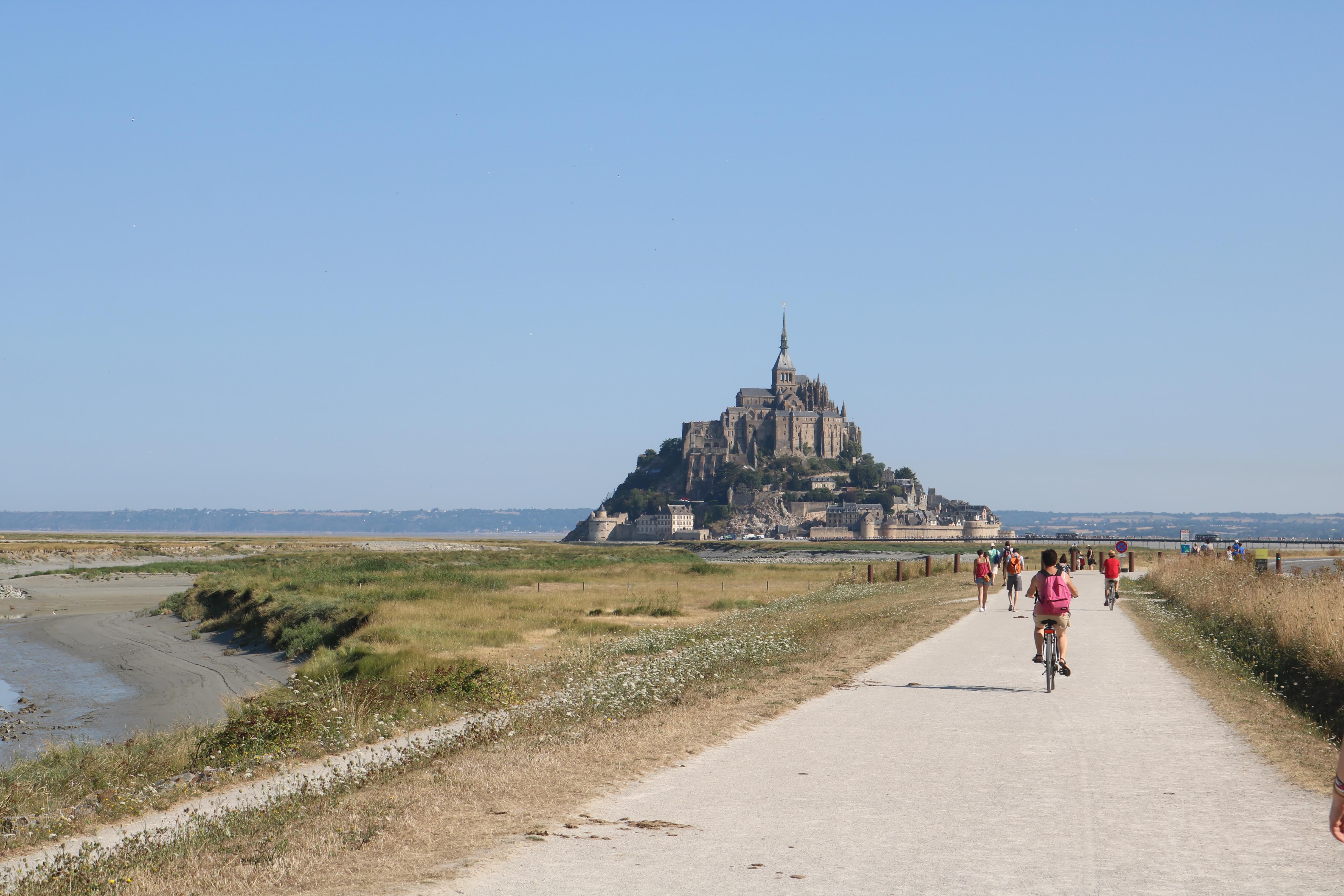
So now you approach as pilgrims have for 1200 years: you walk. I had been warned about the crowds here, too, it being the second most visited monument in all of France. Two and a half million people annually. But the expanse of sky and stone, at least on the approach, seems as if it could contain the universe. Moderately loaded “Navarettes” tastefully paneled to look like boats, shuttle folks to the island, passing in their mission the horse-drawn carts for people who really had it to spend. We take the 30-minute footpath and have time to let the beauty and sheer magnificence of the site come rolling into our consciousness with the tides. It is another hot day and we are now an intentional little troupe of six. So if there are to be crowds in these doll-sized streets and narrow passageway we should go all the way to the top, tour the Abbey itself, and then work our way down. So up we go. This is an inhabited island, so we do pass little houses, but mostly it has surrendered to tourists and tourist businesses. The inhabitants of this tiny town of 247 acres (about one-third of a square mile) equal approximately 30 permanent residents: a dozen monks, two priests, a few hoteliers and an old lady, now aged 93. Apparently, only one in three of the annual almost 3 million visitors ever make it to the top, where the Abbey sits waiting. I quickly can see why: There are steps, and more steps, and then there are steps. There are not really “streets” so much as more steps. I laugh that the main street, at most the width of two men’s shoulders, is called “Le Grande Rue.” Ah well. There are other ways to be grand.
We gathered on the western parvis to await our guide – en francais, who turned up in a plaid shirt looking exactly like Mr. Bean. He did! Ellie and Sophie both shush me for offering this pleasant observation. Unfortunately, he spoke so quickly and packed so much information into his presentation that I was sorry not to understand more than six words. Ellie seemed to, and my other traveling companions did, so what did it matter that after every declamation at this spot or that, the crowds would chuckle or bust out laughing at some joke I had missed entirely. That’s OK. We toured the abbey like that, Ellie and the Famille Boutrous banded in and engaged with Monsieur le Bean, and me surreptitiously sidling up to a guide Anglais, who was wearing a special badge which meant her group had paid $$ and would go up the lace staircase. We had not paid money and so would not see the “Escalier de Dentelle,” but I was content to stand within earshot and hear her English tidbits, trying to look like a confused French woman. With almost no effort, Sophie stood looking like a bored American girl (if she didn’t like museums before this trip she had discovered a newfound ennui for ancient historic ruins–particularly those shown by a long-winded fast-talking orator in a foreign tongue in a slooooow moving group in the 90 degree heat.) We toured a lot of the Abbey–the church, the cloisters, the refectory, the monks’ workroom, the guard room, alms-room, and what remains of the dormitories—just enough to enthrall Ellie and frustrate Sophie, who couldn’t understand a word. So she wandered, only loosely tethered to our slow moving group and sometimes out of sight completely and I wasn’t sure how she intended to rejoin our little group, as it was indeed super crowded and always moving in one direction.
It wasn’t until later when I saw the pictures she took that I understood. She had discovered a different way to experience the abbey that day, and the language of beauty and wonder had not escaped her. Tucked between photos of seagulls (LOTS of photos of gulls), were gorgeous, sweeping panoramas where, in the endless multi-hued mud flats of low tide, the abbey was reflected. There were close-ups of architectural detail–doorways and steep windows overlooking the bay and the many petticoat layers of this well-rooved town. There were photos pointed from the walls straight upward (right up the spine of the merveille) and then outward (33 km to England!) across the huge expanse of flat sand and even flatter sea. Later, Ellie told me that most of the morning she was near tears. So spectacularly moving was the scenery that she had to keep her face down as she listened to Monsieur le guide because she feared she might begin to weep with wonder and joy. It was that kind of place.
We were up there long enough for the island to empty itself of temporary tourists, the busloads of folks just passing through who had to be in Versailles by nightfall, having only the morning to give and already gone on down the road. Serving an itinerary like marching orders. When we came out of the abbey the streets were not nearly as impassable. Then there was the little lunch 2-step where we stood, late in the day, famished at a kiosk or counter selling filled baguettes on the street—perfect! We will grab a bite and an Orangina, escape to the ramparts, picnic there…Sophie’s eyes light up and she is making her selection when the rest of our group decides a sit-down meal is in order. I can feel her stiffen with anger at the prospect – we do not want another one of these, but she and I have taken to sharing a plate and it suits us fine. Faster, cheaper, less to eat; more to feast on saved time and full (enough) wallets.
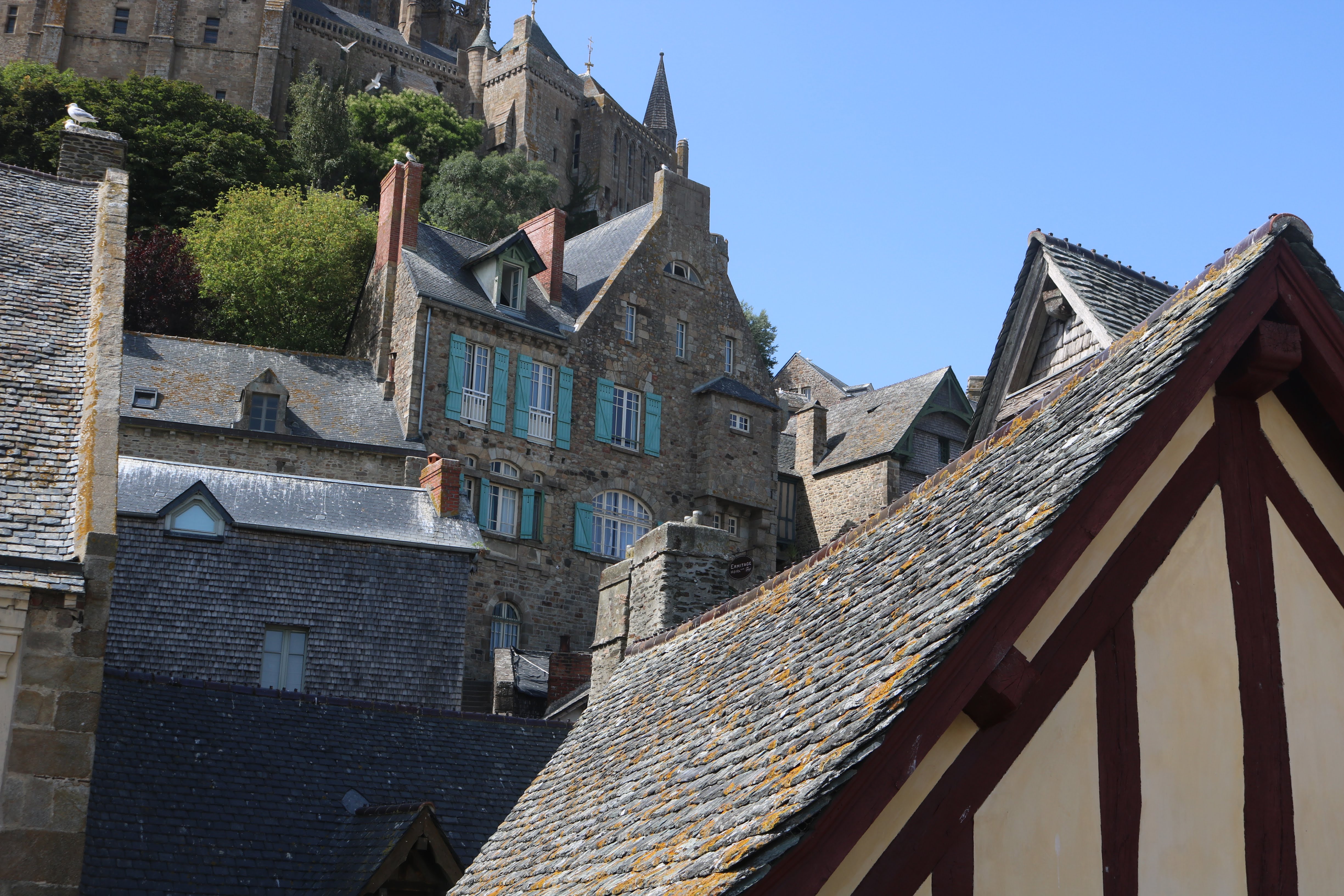
After lunch we are refreshed and ready for more touring on foot, and this time instead or worming our way through the crowded streets we take the ramparts around the outside of the little village. From here we have the best of both worlds: up one level from the street, we can peek through the curtains of hotel dining rooms and studio apartments of the town, while all along to our left was the wall, then the sheer rock drop to the beach, and then miles of sand for as far as the eye could see. It was fabulous! Much more passable—and more fun—peeking into all the little courtyards and being eye-to-eye with centuries-old houses and architecture. Most of the bricks I can all but touch have occupied their solid spots for close to 600 years. I pass within breathing distance of a house from the 15th C—the oldest house on the island, which is right next door to the “Artichoke House” – also very old and so named for the strange tufted pinnacles on the roof that resemble an artichoke. We discovered hidden parks, gardens, and vantage points to sit a minute which, after such a long lunch suited everyone–except Sophie and me. She –and I as well, to a lesser degree–so wanted to keep moving and leave no hidden little path untrod. But I was worried she would not come back. I was worried for her in those crowded streets, not speaking or understanding the language, not much able to read signs or maps or get quick help. Mainly just a long-legged beauty traveling solo and, should something happen, advertising quite quickly her helplessness. So this was not in my plans, to let go. Indeed, it wasn’t until we got home, a week later to the U.S. and we were in Dulles airport waiting in Customs line and Sophie up quick said she’d be right back, going to the restroom–that I panicked, and then just as quickly realized how locked up about that I had been the entire trip.
On this hot, intense and overwhelming day, however, she begged to be free. To go it alone, as I had done so many decades ago. Much of our group wanted to visit the few little museums and Sophie–not so much. So go, little gull. After the lunch, I gave her flight. On a paper napkin, I wrote out her name and the cell phone for both Mme and M Boutros, cautioned her not to accept help from anyone who offered it, and waited while she shoved the paper into her pocket, scowling at me the whole time. By “after lunch” I mean 4 pm. Everything ran later there, and especially on this island. I remember the year I traveled through Spain (alone!!) when I could not eat dinner because I did not want to be out on the streets at 10 pm. by myself. Wondering why on the earth they couldn’t just eat at 6 like the rest of the world. See?? The world is indeed a dangerous place, and I knew it then.
In any event, off goes my one free admission to the museum. I watch her go, quickly swallowed up in the crowded streets and then gone from sight, while the rest of us gather to tour the Musee Historique. What a hysterical collection of one man’s–or one island’s–“treasures”! All of the museums on the island are 200 years old or more. That would explain the giant, wall-sized (16 FOOT wall-sized) portrait of King Louis XIV painted by Charles le Brun — stuck in a glass case equally huge but also in equal disrepair–dusty, faded, even torn in some places on the canvas and quite clearly off every curator’s radar. He was THE court painter for Louis IV in the 17th century, the esteemed “first painter” to the king. And here is his work, 220 miles from Versailles and even further from Paris, languishing on half-display for four hundred years! Mont St Michel has been a tourist destination for perhaps a day longer than it has been a religious destination, which is about 1200 years. So the “museums” there reflect most the passage of time and a sort of other-worldly approach to curation (as in, We sent all our good guys up to Paris!!) Like the careful collections of a child, where everything is important and each piece unique and precious, the rooms are filled with case after case of like items. Pocket watch innards. Rusted weaponry. Stuff dug up over the years on archeological forays, bits too tiny to be recognizable but proudly on display nonetheless, usually with a tired index card next to it telling what it is (or was). Throughout much of the “museum,” the “display cases” and the signage itself is over 200 hundred years old! In one room, I start to notice that all of the wood fragments, carvings, turning and spindles are from the exact same time period. Turns out they are busted-up pieces of furniture and stairway banisters from when the revolutionaries sacked the prison held here during the French Revolution. And because this is Mt St Michel, even a kicked apart kitchen chair is sacred.
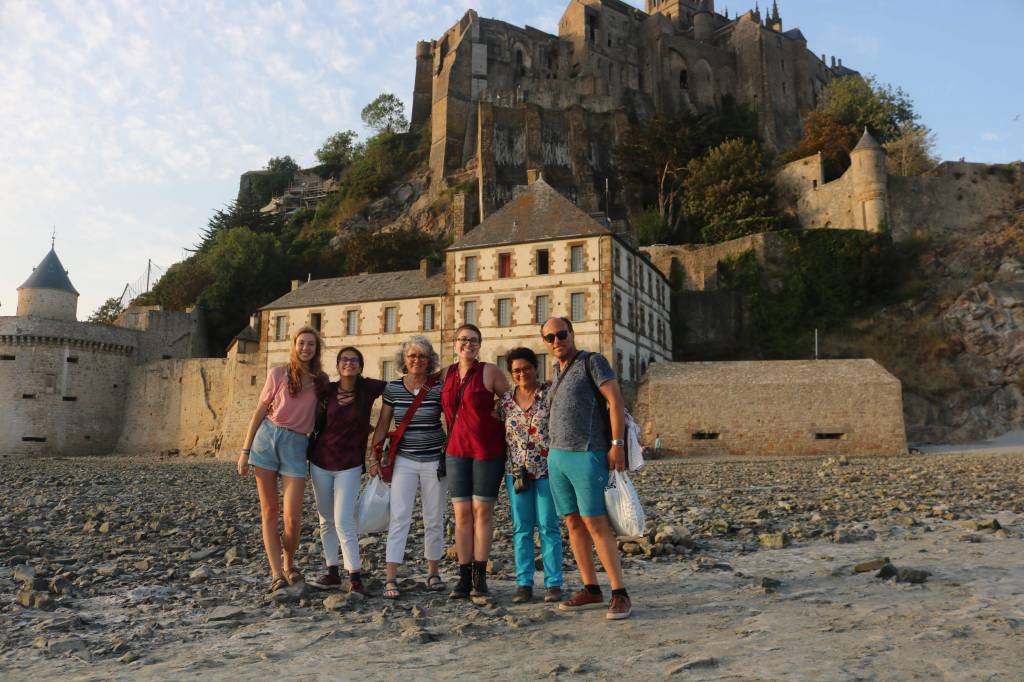
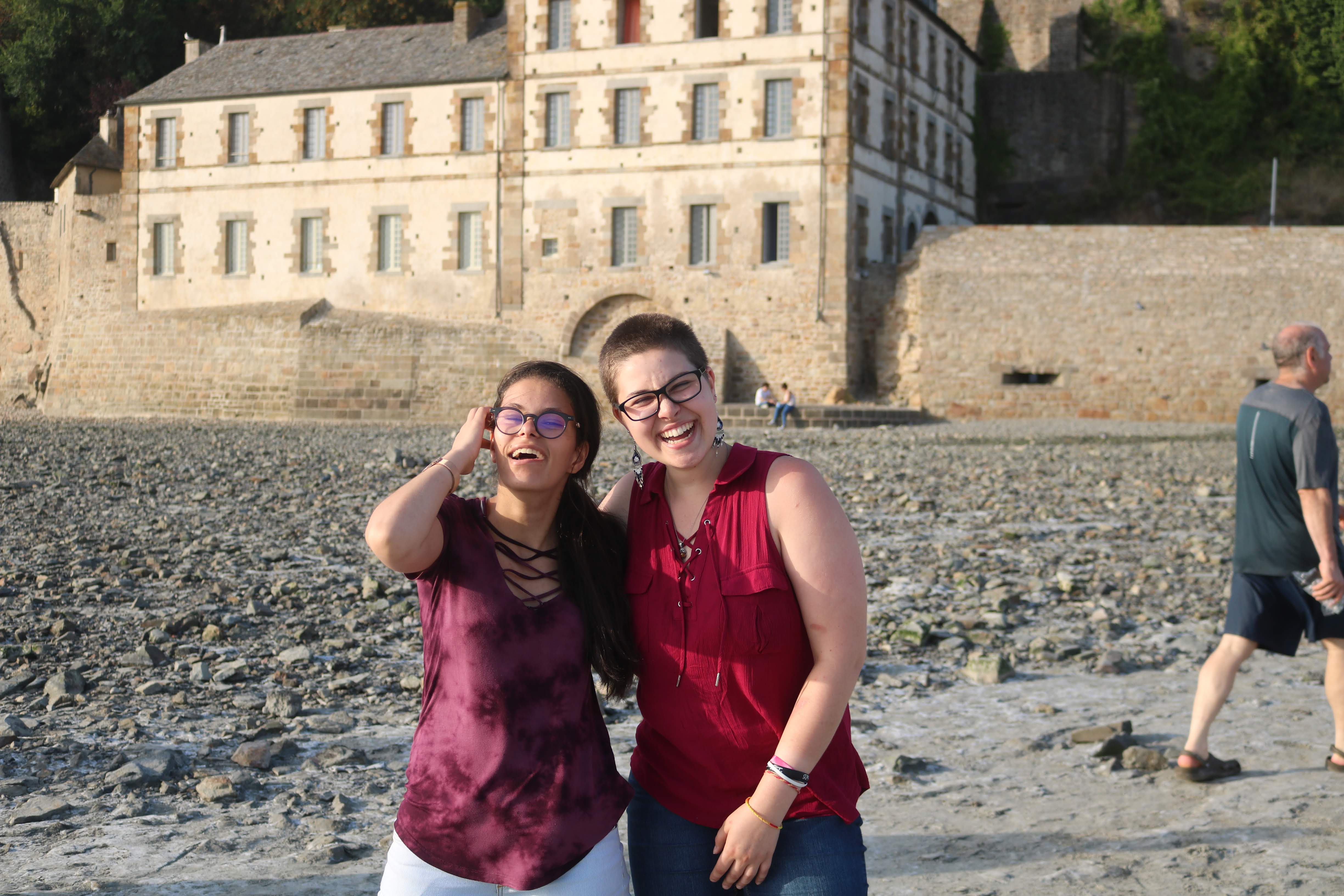
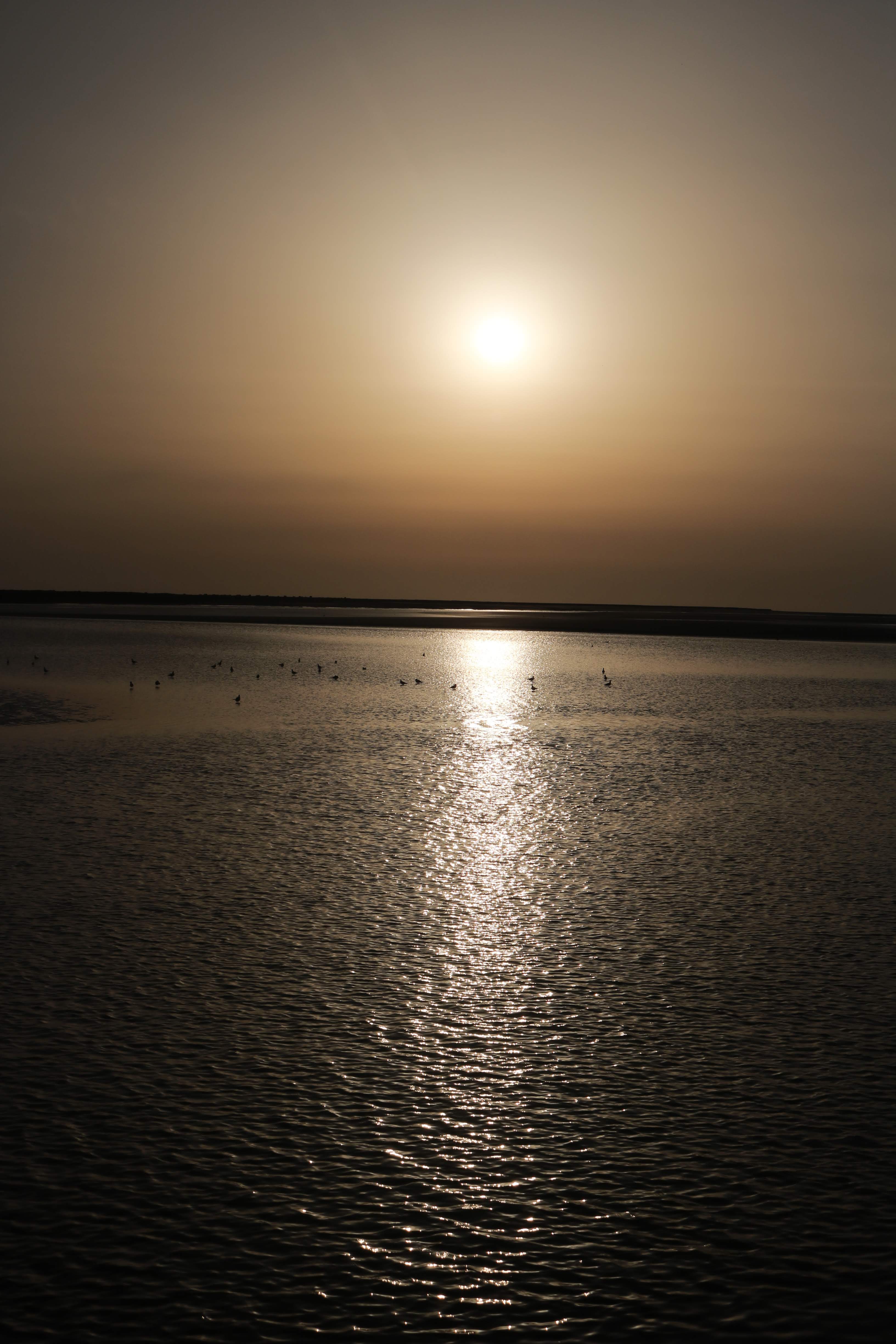
I am at the agreed-upon meeting spot ten minutes before the agreed-upon meeting time. The chaos and clamor of the day have trickled away, so now the shop fronts are visible, and the doorways that open to the street (along with the streets themselves), and the pretty window displays. It is clear the island will be closing –shopkeepers sweeping the dust and grit from the street curbs in front of their shops, little doors going closed and shuttered. We rest leaning against a low stone wall waiting for Sophie to fly in from wherever she has been the past two hours, and when she does we make our way back through the entrance gate and out onto the beach. I am trying not to turn around in melodrama for one last goodbye. This was a hard won journey in the budget traveler’s book of tricks. Will I return here in another thirty? Not likely. Maybe. But not likely. So I try very hard to soak up this sun, sinking down over the glowing line of sea. This moment, pierced by gulls’ incessant calling, luring us onto the cool moist beach, where the girls proceed to make an even louder ruckus with their cavorting photo shoot. This evening, quieting and receding with the tides, this moment in time which slows as does our walking, and then our talking, and then, even our breathing.
They say the beach surrounding the island is dangerous, and that the changing tides can take people unawares. Each year, they say, helicopters come to rescue the “stupid” tourists who gambled with nature–and lost. YouTube has clips of people waist deep in quicksand (and still filming) or watching their car being swallowed up by the swirling silt and liquid sand (and still filming!). These are the highest tides in all Europe, and they can roll in at the pace of a galloping horse (an 18th-century reference point, if ever there were one!), with a 45-foot difference between high and low tides. But in this, the last vestiges of the longest day, we decide the beach is okay, if we remain close to the Abbey walls. There is a rock jetty constructed as part of the canal and here you can get all the way to the water’s edge. Anoukis wants to learn how to skip stones, and there are some really flat ones here. Beauties. Ellie wants to write. Sophie wants to catch a sea gull. The adults sit carefully on the sun-warmed rocks, bone weary and achy from a day entirely on foot and happy to be still while the sun sets in front of us, or no–it is all around us, the fading light dancing on the water and on the sea-sleek sands, now exposed by the receding tides and carrying home all the sweet memories of this day.
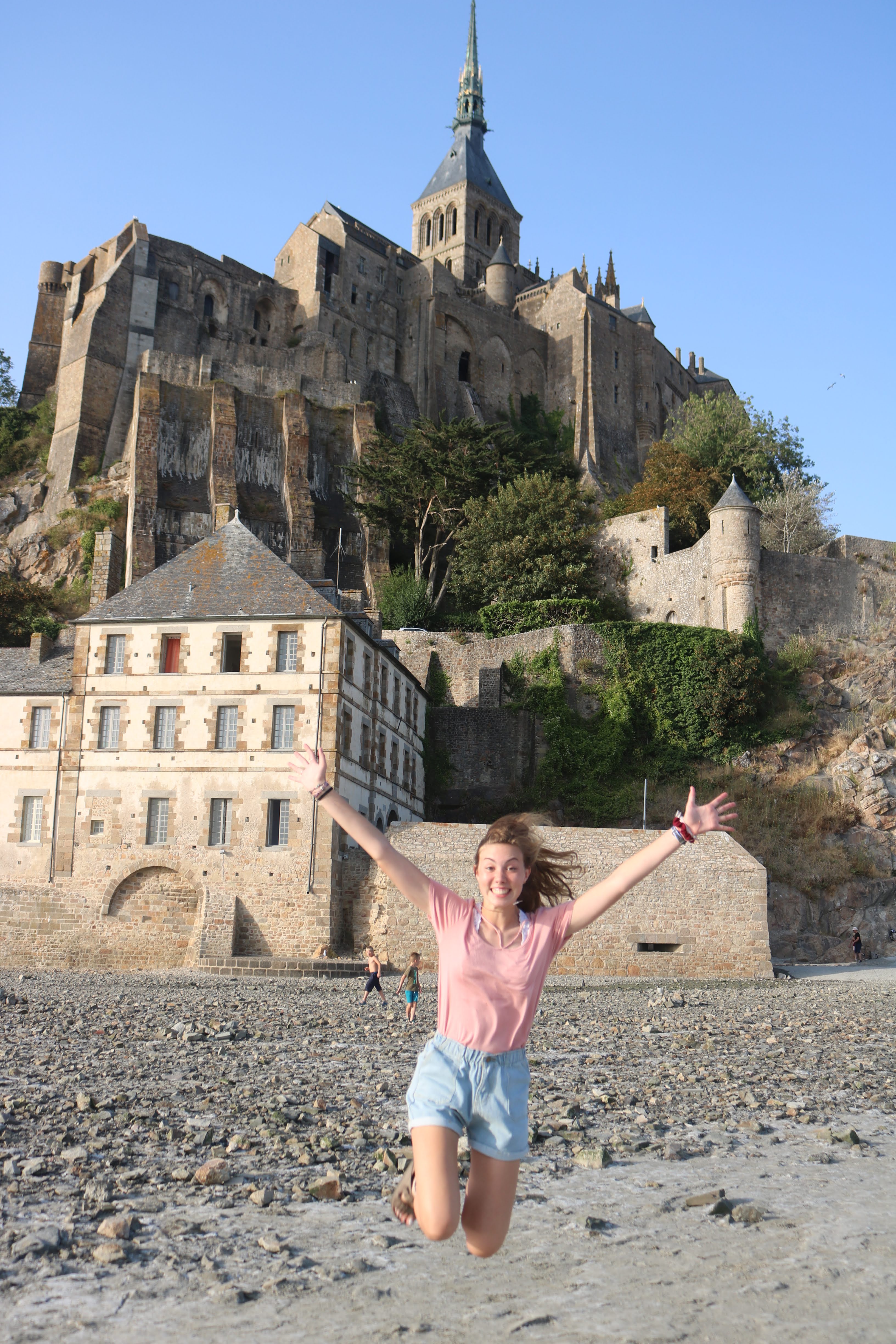
“Bonjour. Je m’appelee Sophie. Je suis perdue. Si’il vous plait, m’aidez…”
We got lost this day. But not in the way that was a problem. Not at all.

 Souvenirs
Leave a comment