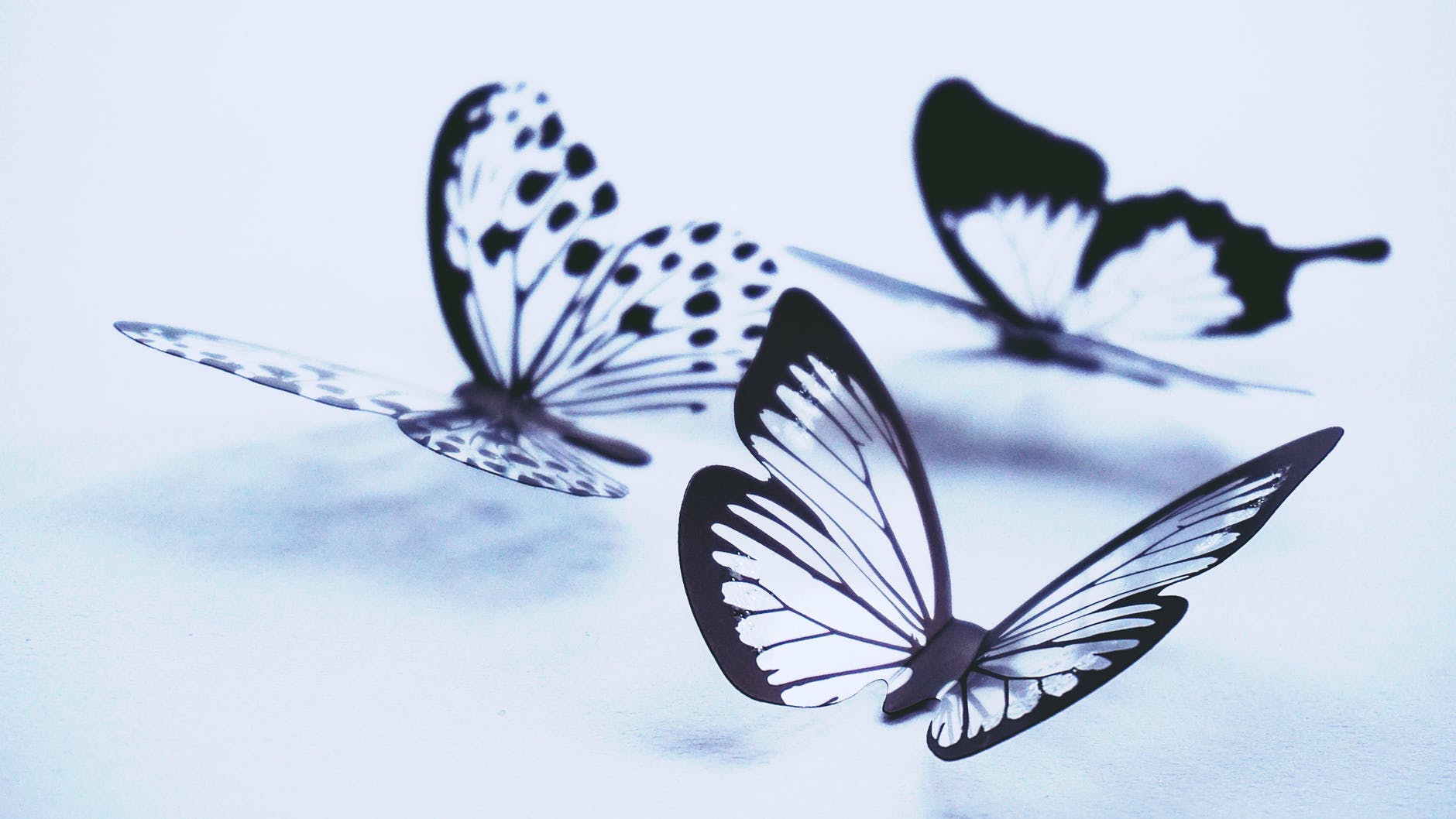
Of all the props, puppets, and flannel board pieces that live in the resource closet of the library where I work as children’s storyteller, my favorite is the butterfly jar. We have a hungry stuffed caterpillar with his tin lunchbox containing a plastic feast, we have Clifford the big red dog, we have the “old lady puppet” with an exaggerated wide mouth who can swallow, oh…I don’t know why, various insects and farm animals, including a horse (She’s dead of course). But my favorite is the Butterfly Jar. About the size of a real mason jar, with a tin screw-on lid that hides a battery pack, my little jar contains a single paper monarch. The delicate creature inside is as detailed and realistic as can be, attached to the lid and the hidden mechanism by a thin filament, so that when you remove the lid and switch the mechanism to “on,” it twists the wire in such a way that the butterfly flits and flaps against the glass walls and appears to fly about in the jar.
As props go, it is purely mesmerizing. You can feel the electricity in their tiny faces–eyes bright, mouths open in wonder and silenced by awe; sometimes they visibly shake with excitement, my preschool audience. I can usually elicit quite a response–squeals and gasps of surprise and delight–not to mention wonder, at what such unexpected vitality is doing inside a jar inside a library. (Hmmmm, kind of the concept behind all those books on the shelves in here, kids, but we’ll get to that later.) Way overstimulated and desensitized to so much these days, children are still arrested by beauty. And here is beauty, primitive and perfect, alive in a clasp-able jar. The fire-colored monarch hovers and flits, holding still and pulsing its wings, then, especially when you tap the jar, flapping insistently and excitedly for release. Like a kid. It plays for even the most wooden performer, and I have gotten good at producing my jar, and marveling over its contents, studying it with an entomologist’s nerdy glee and wondering, playing my audience, wondering–then tap, SWOOP! she’s off, my little ephemeral dancing butterfly, carrying with her the imagination of another clutch of delighted children.
This past summer I got a different response. A girl a little older than the others criss-cross apple sauce on the carpet got up on her knees to point at the jar and protest, loudly, “It’s not real! It’s just a toy. I know it. It’s not real! The other children were stunned. They looked at me surprised, then back at the jar, crestfallen. Could it be? “Just” a toy? Just a toy?! Why in my day, toys were decidedly real at certain times of day and certain times of year. What of Miss Flora Mc Flimsey, whose tatters were turned to a dancing gown by the angel off the top of the Christmas tree? What of the steadfast toy soldier, who journeyed through the belly of a fish and whose love was as indestructible as he was? By one count of children’s literature, there are almost 200 books about sentient toys–stories in which dolls, stuffed animals, or other toys come to life. And I grew up with the magic of that–not that Santa would come with a sack of new stuff, but that the old stuff we so loved during the day had life in it. I’ll give you ‘not real’! On Christmas eve, dolls that spent the entire year flat on their backs on matchbox beds or frozen in place at the bathroom sink didn’t need Hunca Munca to smash the plaster feast for them, they could make their way through the house just fine. And teddy bears had free reign of whole department stores after dark to search for a lost button. A little lost button is a big deal. When you are five.
But nowadays five is just about done and disenchanted and probably getting a Tablet under the tree. Indeed, they start even younger than that. I have a wee one in my toddler story time who is often late because the grandmother “can’t get her off her laptop.” What??! That’s a gran I’d like to feed to the wolf. We have a “tot-spot” by the door of our story time room complete with colorful little monitor and keyboard–a kiddie-puter loaded with the latest games for the “developing” mind. Perhaps we set up a table on the other side loaded with candy for their developing bodies?? Screen time for two-year- olds–what is THAT? Two-year-olds! Been alive on the planet a little over 700 days and you got nothing new or better to try? Has life so short-changed your little one that we are now needing to supplement “ordinary” life?? Something wrong with the change of seasons and finger paint? Baking cookies lost its zing? Mudpuddles, play-dough, live animals, dress ups and a decent, cell-rebuilding NAP not doing it for you? Got to “advance” your TODDLER with screen time?? The idea of it boggles the mind.
Said better and far more prophetically by a 4-foot tall Oompah Loompah (on TV, the Instagram of his day):
IT ROTS THE SENSES IN THE HEAD!
IT KILLS IMAGINATION DEAD!
IT CLOGS AND CLUTTERS UP THE MIND!
IT MAKES A CHILD SO DULL AND BLIND
HE CAN NO LONGER UNDERSTAND
A FANTASY, A FAIRYLAND!
HIS BRAIN BECOMES AS SOFT AS CHEESE!
HIS POWERS OF THINKING RUST AND FREEZE!
HE CANNOT THINK–HE ONLY SEES!
― Roald Dahl, Charlie and the Chocolate Factory
I have some depressing news from my random sampling of the tots I see each week. They don’t “see” so well these days either, because of the screen time they’ve logged in before their third birthdays. I can’t always catch them any more, not even with a full array of voices and the most beautiful illustrations. Why, story books used to pull my children out of tantrums and away from mischief and down from the ceiling. In those days. Like I’m saying. Magic. You be surprised the children I come across today who don’t know what you can do with a purple crayon, what snozcumbers are and who have never been on a bear hunt. What??! On the door to the story time room I hung a poster of 100 Best Books ever written for children, and I often point to it. Or I’ll say, at the end of reading a story, “One down, 99 more to go.” I love reading aloud to children. I love a well-written picture book, with life at its center and action in its pages. In a really, really good one, the illustrations tell a secret on me even in the very act of turning the pages while I read, and the rare child who is able to pay attention (not just “sit still and listen,” which even a dog can do), will a have a secret conspiracy with the story before I am even finished reading it, and her imagination will be long gone, leaving “The End” as a kindly but unnecessary wave as she soars above in delighted flight.
Even from before parenting, and then reinforced because of it, I did not know you could dispense with the 100 best books. I did not know you could actually raise a child without them, and boy do I feel like a dope that so many are doing it today, all from the ease of a cell phone, tablet, or some trending kiddie device. All that time spent laying on a nursery floor or snuggled up in bed or curled up in a midday chair, my arms around my favorite little bear, stilling a moment, soothing a day, working a sweet gem of moral truth into being or just charming them to giggle and laugh, all with the sound of my voice. (Ahhh, for that superpower today! “Hello, later adolescent and largely disagreeable people: ‘Once upon a time…’”) Honestly, I don’t see why people don’t reclaim this easy art of godhead in their wee ones’ lives, rather than bark at their kid in the grocery once minute and then hand him an iPhone the next to keep him quiet. I have a much easier way. A book can radically alter a moment, a day, a family, a child. A story time can work miracles. Poster hanging in one NC library: “There is no App to replace your lap. READ to your child.”
Remember, I have seen the future. And it doesn’t take a crystal ball. All it takes is a sub badge and a few days spent two miles up the road at our high school. Being there a few days, I can usually tell who’s had the 100 best books. In a day. In a single class in a single day. They don’t glow and they don’t have three heads, but these students look you in the eye and they make conversation and they usually have cool ideas and more mature ways to express them. I am not surprised when they write well. Back at story time twice a week, I feel as though I’ve travelled there in a time machine, where moms younger than some of the clothes in my closet prop their beautifully dressed beamers in their laps (hands free) to send or receive a quick text. And yes, I really do see moms bribe their kids with candy to get them off the “tot-spot” to enter the room. I want to spin in an arc round my story time circle and swat those cell phones from the mama’s hands. Mirror, mirror on the wall, you are all…your child will see and do when she is tall. What I want to tell the mom logging her in is, don’t hand a two-year-old a tablet if you’re not willing to take it away from her at 10 and you don’t want her glued to it at 15. Newsflash, world: They’re connected. And the what, when, who, where, how and why you do with this child today will be there waiting for you at the other end. Did you think it otherwise? Or did you suppose you, too, could push a button someday to get the bright-happy-balanced-and-kind one you always wanted?
The last time I subbed in a high school English class, an IB English class (highest rigour in the land) the kids were reading and analyzing Lord of the Flies. Not a paper book in sight. I’m assigned a laptop cart with 19 laptops for a class of 26 students. (Laptop #20 is out on repair). The main lesson of the day (90 minute class, mind you) is to watch a video on figurative language before tackling an analysis of the text. No surprise, seven laptops short, a few won’t turn on, a few more will turn on but not load, and all–yes all!–will be prevented from the school firewall from accessing the assigned video. Out come the ^%$#@! cell phones I’d asked them to put away as they walked through the door. So now, only those with unlimited data are going to be able to access this all-encompassing video upon which the day’s lesson hangs. The rest of the students are gone, done, checked out, elsewhere. The modern trilogy: me, my phone, and I. I make my way around a class-full of our brightest and best, now busy texting friends about the weekend, looking up yesterday’s football scores, and playing Fortnite. Casually I stop by the desk of one fully-wired brownnoser to see what this end-all be-all video is about. Like, what is it that has so derailed the class that we cannot think, learn, or complete an intelligent assignment on a master work of English lit with a book in our hands? What is it? A little cartoon off YouTube on metaphors and similes! Stuff they’ve had since second grade! And every school year since! I got one for you. Mind-numbing like a dead Rhopalocera in the bottom of a jar.
Why is there is such a swoon and fuss over electronics in the making of people? Why did we abandon the old user-friendly platform of gorgeous, award-winning children’s picture books? It’s the missing ingredient, the piece we’ve all been waiting for that will finally make education great again. Where is my little whistle blower now? Boy could I use her, pressing and pushing her little know-it-all into the crowd of goers and gawkers, as they fawn over the latest in technology paraded out before the king. Or was it an emperor, buying into a beautiful duds that the dullest among us can’t see. We all know the emperor was sold a bill of goods. But we sure go in for it. Every time. Technology in the classroom. “Smart boards” hanging in the spot where smart teachers used to teach. Climbing through a technological wormhole to wait for and access, forgive me, drivel. Come, on wee one, let them know: It’s not real! It’s just a toy! Indeed. And yet we wait while they spin and weave and churn out apps and snaps and chats and platforms–for what? For what?! Some of the greatest ideas ever thunk are on the shelves right now! I won’t insult you by referring you to a card catalog, but surely paper books are practically a novelty by now and sure to knock their socks off. Crazy talk.
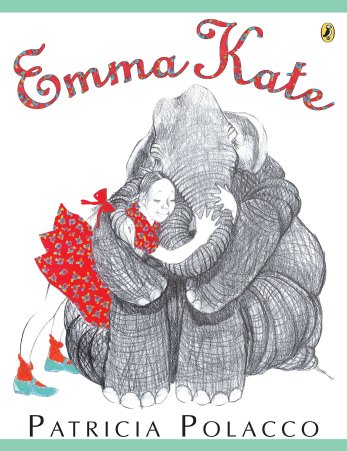 One of my favorite stories to share is the book Emma Kate, by Patricia Polacco. In the story, a childlike narrator is telling us all about her (imaginary) friend, Emma Kate. The story is crafted using the age-old trope of the invisible side-kick that the adult world can’t see or acknowledge but who provides great amusement, adventure and companionship for the young narrator. The pictures are equally charming–a pig tailed and freckled girl drawn in dangly pencil with her braids flying behind her and socks saggy around her ankles like–well, like an elephant. Which is funny because that is just the “toy” and the perceived imaginary friend in this story–an elephant. Think Calvin and Hobbes, where Hobbes is a walking talking potbellied and tiger when he’s alone with Calvin, and a lifeless stuffed animal with button eyes when an adult is around. Adults spoil everything, after all. So in this book, the last few delightful illustrations are of a full-sized elephant in the bubble bath, and busting the bed as the pair share their nighttime routine–but wait, what’s this? The print from the girl’s dress has become the coverlet and her hairbows the curtain tiebacks and mamma and papa ELEPHANT are tucking the little narrator ELEPHANT into bed while she snuggles with her DOLL named Emma Kate! Do you get it? (Sometimes I have to ask my kids this, too). Do you get it? Did you see it? The shift is so subtle, it could even missed by the pushbutton set. The pictures carry the story anyway, so if you are paying way attention you will get it. Like life. Wonderful, wordless life. If you study it and pay attention really hard, the story will still carry you away.
In my day, dear one, spiders spun verse on barn eaves and swans spoke (and played trumpet), and mice drove miniature cars just to get out on the open road–why the world was filled with MAGIC, deliciously enrapturing magic all around, if one could but notice it. In my day all you needed to be King all Wild Things was a costume. Preferably a wolf suit. Today, the wild rumpus has been silenced by screens, and the wild ones have become, well, rather dull. Like butterfly jar girl. Like the listeners who can’t tell the difference between an elephant and a girl. Or maybe it’s that they can’t conceive of having an imaginary girl. Which is exactly what you would have if you were an elephant. I’ll tell what’s real and not real. There’s a reason they call them “flat” screens, my dear. Quid est quod vos adepto.* And that device is going to kill whatever had a breath of life in it. It’s good to be “advanced,” I guess, but be careful what you advance. Inanity, Captain Underpants, doesn’t count. And if a child under five doesn’t know how to play Poohsticks, spot fairies, build a house from a box or jump start your average sofa for a long-distance journey, then I say what advancement? Where??? Childhood remediation all around. I suppose when YOU open the wardrobe, Muggle girl, all you see is coats. Child, have you not studied the rabbits in the garden in the gathering dusk on a wet spring eve (DO they indeed have seams??) or chased fireflies glinting in the trees? “Real” is something the world can’t touch. “Real” is something that age and time can never take away.
Just ask the skin horse.
“Real isn’t how you are made,’ said the Skin Horse. ‘It’s a thing that happens to you. When a child loves you for a long, long time, not just to play with, but REALLY loves you, then you become Real.’
‘Does it hurt?’ asked the Rabbit.
‘Sometimes,’ said the Skin Horse, for he was always truthful. ‘When you are Real you don’t mind being hurt.’
‘Does it happen all at once, like being wound up,’ he asked, ‘or bit by bit?’
‘It doesn’t happen all at once,’ said the Skin Horse. ‘You become. It takes a long time. That’s why it doesn’t happen often to people who break easily, or have sharp edges, or who have to be carefully kept. Generally, by the time you are Real, most of your hair has been loved off, and your eyes drop out and you get loose in the joints and very shabby. But these things don’t matter at all, because once you are Real you can’t be ugly, except to people who don’t understand.”
― Margery Williams, The Velveteen Rabbit
I am unashamed, five decades into it, to admit I grew up believing that. It was like a daily, private Santa Claus reality that infused every moment of every day, instead of firing him up once every 365 to elicit some decent behavior out of barbarians, who, after scoring their brand-new devices, revert to well-dressed Neanderthals. And the books we read didn’t point to themselves so much, or to our own self-gratification or want. Instead it was unspoken, shared agreement: they all pointed to the same world, where imagination reigned and almost anything was possible. They were all based on loosely the same premise: that love is a super power that brings life and hope. Most of the time in kiddie lit, foxes get a bad wrap. Right up there with the wolf, they are always lurking about and scheming for their lunch. This one in The Little Prince, however, had it just about right I think:
On ne voit bien qu’avec le coeur.
L’essential est invisible pour les yeux.
Le renard (Le Petit Prince)
It is only with the heart that one sees well.
The essential is invisible to the eye.
The fox.
Now. For the good news. It is never too late. Never too late to unplug. You may need to don pajamas (symbol of childhood), you may need to bare your feet (symbol of innocence), and you may need to close your eyes (half-blind by this time anyway). About this point you’ll remember there are actually five senses, not just thumbs, and if you employ them all with the sweet abandon of say, a four your old, and if you listen really, really hard into the snowy cold stillness all around you, you may well hear it. Can you? Do you? Hear it? Listen.

The sound of a single silver sleigh-bell.
THAT’S what is real.
*Flat screens: What you see is what you get.


 Souvenirs
Leave a comment